
" Grow Zambia" , Inside Hichilema's Plan for a Second Term
·September 2, 2026
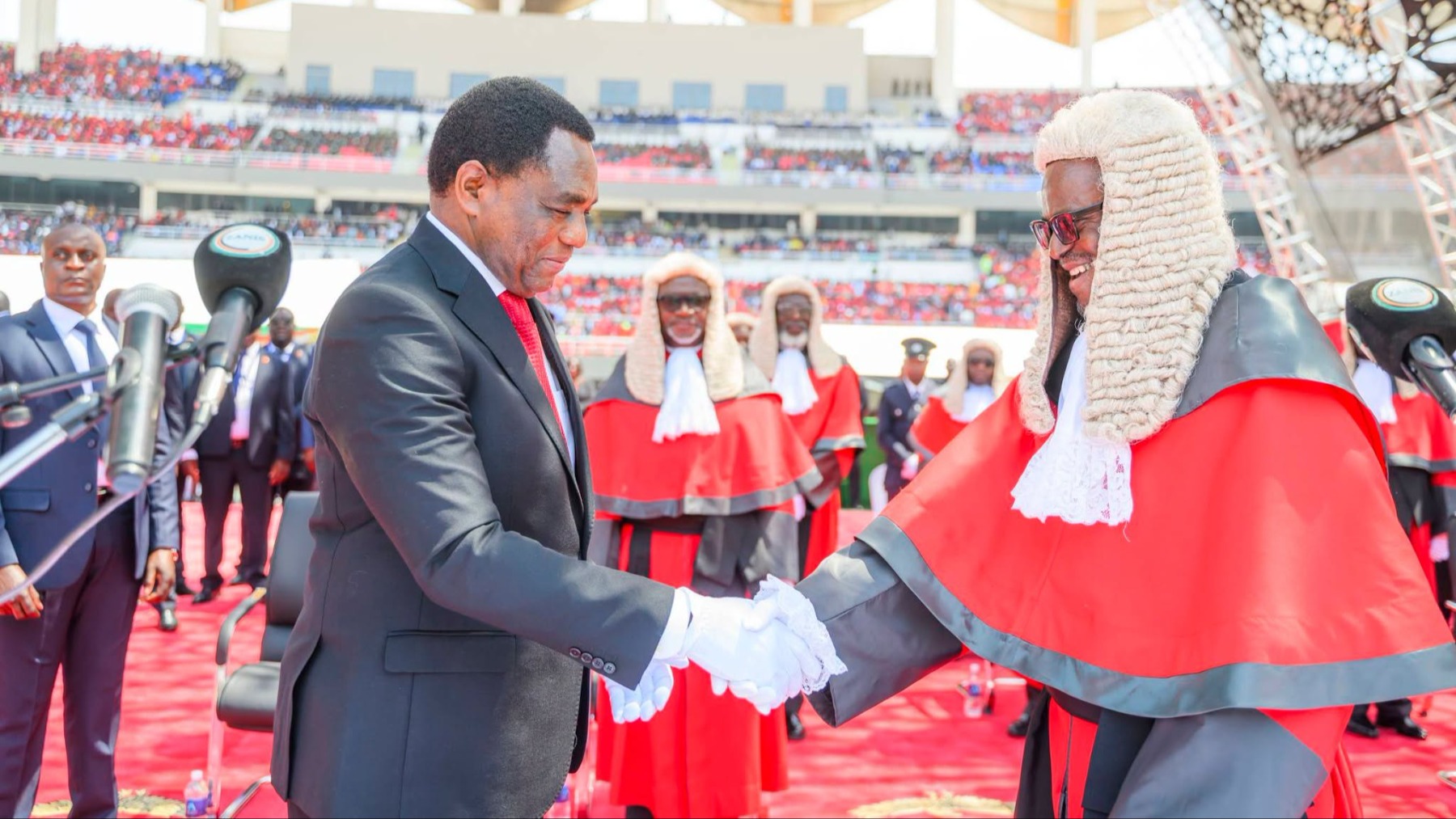
President Hakainde Hichilema used his inauguration address at National Heroes Stadium on 1 September to name the defining project of his second term, the "Grow Zambia" agenda, framing his first five years as the period of economic stabilisation and the next five as the period in which that stability is meant to translate into visible, shared growth.
FROM STABILISATION TO A NUMBERED AGENDA
Hichilema opened by crediting his first term with restructuring Zambia's external debt, pushing international reserves to their highest level on record, reducing inflation to its lowest point in eight years, stabilising the kwacha, and making free education a legally protected reality that he said brought 2.6 million additional children into school. He also pointed to an enhanced Constituency Development Fund, expanded social protection programmes, and the introduction of a proportional representation system he said has widened participation for women, young people and persons with disabilities in Parliament and local government.
But he was direct about what that record has not yet delivered. "We know that for many families, the cost of living has remained challenging, and that the benefits of our stabilisation have not yet been felt at every level," he said. "We hear you."
That acknowledgment set up the speech's central pivot. That is, having done what he called "the heavy lifting" on stabilising the economy, the next five years are about growth, expansion, opportunity and prosperity, values he compressed into a single memorable formula, 10-10-5-3-3-1-1-1.
It covers10 million tonnes of maize, 10,000 megawatts of electricity, 5 million tourists, 3 million tonnes each of copper and soya, and 1 million tonnes each of wheat and sugar, alongside $1 billion in beef export revenue. Hichilema said the agenda is designed to more than double the size of Zambia's economy, and framed growth in explicitly personal terms rather than abstract statistics.
"Economic growth must mean something at the dinner table," he said. "It must mean education for our children, a job for a young graduate, a market for a farmer, capital for an entrepreneur, opportunity for a woman in business and a better future for every child."
A MINDSET SHIFT, AND A HARDER LINE ON THE PUBLIC SERVICE
Hichilema devoted part of the address to what he called a necessary cultural shift away from what he termed the "Tantameni," or handout, syndrome, a habit of thinking only about today rather than tomorrow that he said had been entrenched over many years and could not be undone overnight.
He paired that with a pledge to continue transforming the public service into what he called an effective, efficient and delivery-oriented institution, promising that "the fight against corruption will intensify" and that public resources would be protected, telling public servants that national interest must come before personal interest.
A MESSAGE OF RECONCILIATION, SHADOWED BY A DIFFICULT CAMPAIGN
The most striking passages of the speech were not economic. Hichilema repeatedly and deliberately addressed the tone of the country's politics, in language that reads directly against the backdrop of a campaign period MUVI has covered extensively, marked by violence, contested arrests, and the death of former minister Mutotwe Kafwaya. "There must be no taunting, no provocation and no humiliation of those who voted differently," he said. "The person who voted against us is not our enemy. He is our brother. She is our sister. They are fellow Zambians."
Later in the address, he was more explicit still about where competition must never lead. "It should never reach the point where it becomes a matter between life and death," he said. "Life is sacred." He commended all candidates who contested the 2026 elections, calling it an act of courage to submit oneself and one's ideas to the judgement of the people, and extended what he called a hand of unity to those who opposed him, "not as a gesture of political convenience, but as an expression of our conviction that this republic belongs equally to all of us," pledging to listen where opponents offer good ideas and hear them where they offer constructive criticism.
WHAT HE PROMISED GOING FORWARD
Beyond the headline growth targets, Hichilema pledged to scale up investment in education, skills development and healthcare, deepen economic empowerment for women and young people, and accelerate decentralisation, putting more resources and responsibility directly in the hands of local communities. He was specific about geographic reach. "No province will be excluded and no district will be forgotten," he said. "No community will ever feel that they do not matter."
On foreign policy, he said Zambia's approach would remain anchored in economic diplomacy, peace and mutually beneficial cooperation, repeating a line he has used before, "instability anywhere is instability everywhere," and pledged Zambia would remain an investor-friendly, reliable partner and a voice for peace and dialogue internationally.
He closed the address with a personal pledge, "I will continue to be a servant president for all Zambians," before thanking the nation in seven different Zambian languages and calling on citizens to move forward together "as brothers and sisters, united by the land we love, and the future we share."
Stay with MUVI
Follow our reporting wherever you are