Opinion
Zambia Is Quietly Pushing to Become a Big AI Player
By Muvi TV News Desk·July 31, 2026
Over the past nine months, Zambia has quietly assembled the building blocks of an artificial intelligence strategy: a national AI framework, a Huawei-backed data centre partnership, high-level talks with China's premier, and now, founding membership in a new global AI governance body. Taken individually, each is a modest development.
Taken together, they point to a deliberate government bet that Zambia can carve out a role in a technology race still dominated by wealthier nations.
The latest step came on 16 July 2026, when Zambia joined 28 other countries as a founding member of the World Artificial Intelligence Cooperation Organization (WAICO), a new China-launched intergovernmental body aimed at shaping global cooperation and governance on artificial intelligence, the Ministry of Technology and Science has confirmed.
The founding agreement was signed in Shanghai on 16 July 2026 by Zambia's Permanent Secretary in the Ministry of Technology and Science, Dr Brilliant Habeenzu, on behalf of the Zambian government. Chinese Foreign Minister Wang Yi signed first on behalf of the host country.
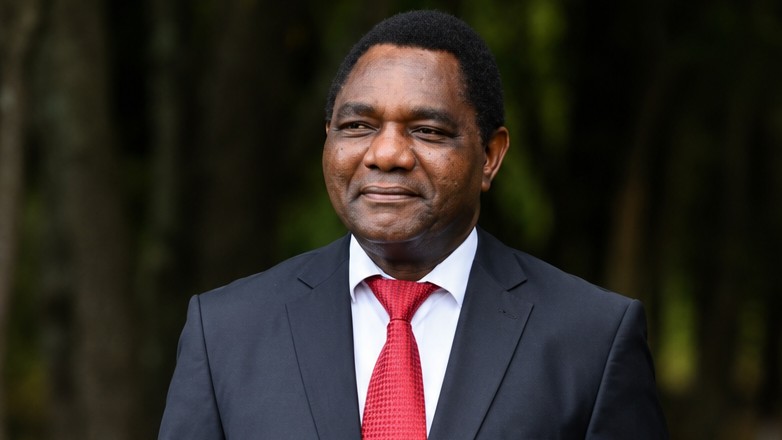
The Ministry said Zambia's membership builds on the National Artificial Intelligence Strategy adopted under President Hakainde Hichilema's administration in November 2024, one of the first such strategies on the continent.
WAICO, headquartered in Shanghai, brings together countries from Africa, Asia, Europe and Latin America, including Algeria, Cameroon, Ethiopia, Kenya, Mozambique, South Africa and Zambia from the continent, alongside Russia, Brazil, Indonesia and others.
Beijing has described the organisation as a platform to promote safe, fair and inclusive AI development and to help narrow the growing AI gap between wealthy and developing nations.
Speaking at the opening of the 2026 World AI Conference in Shanghai the day after the signing, Chinese President Xi Jinping pledged 5,000 AI training and seminar opportunities for developing countries over the next five years, and said WAICO member states would gain access to Chinese computing infrastructure and AI standards frameworks.
Dr Habeenzu and Percy Chinyama, National Coordinator of the SMART Zambia Institute, represented Zambia at the conference.
The Shanghai signing is the latest step in a broader run of Zambia-China cooperation on artificial intelligence.
In November 2025, Chinese Premier Li Qiang, during an official visit to Lusaka, told President Hichilema that China was ready to expand cooperation with Zambia in mining, new energy vehicles and artificial intelligence, building on the zero-tariff trade arrangement extended to Zambian exports.
And in May 2026, Smart Zambia and Huawei Technologies signed a separate memorandum of understanding to co-invest in a National Artificial Intelligence Data Centre and train 5,000 Zambian ICT professionals by 2028, a deal Vice President Mutale Nalumango said would help position Zambia as "a smart, connected and competitive nation."
Zambia currently has no dedicated AI law. The sector is governed by the non-binding 2024 National AI Strategy alongside existing legislation, including the Data Protection Act and the Cyber Security and Cyber Crimes Acts of 2025, with the Ministry of Technology and Science leading policy and ZICTA and the Data Protection Commission serving as regulators.
Whether the strategy pays off will depend on execution as much as ambition. Membership in WAICO and a data centre MOU are commitments on paper, not infrastructure on the ground, and Zambia is entering the race well behind countries with existing chip access, compute capacity and AI talent pipelines.
But for a country positioning itself early, before binding rules or heavy costs are locked in, officials are betting that being a founding member now buys Zambia influence, training slots and infrastructure access later that would be harder to negotiate from the outside.
Stay with MUVI
Follow our reporting wherever you are